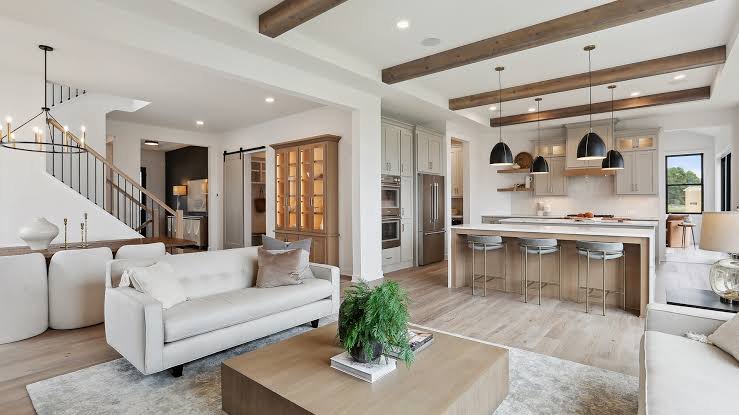
Ever walked into a small flat and felt like you could breathe, while a much bigger house next door felt cramped and cluttered? That’s not luck. That’s design.
If you’re hunting for design tips to make room look bigger, you’ve probably already tried the obvious stuff — pushed the sofa against the wall, bought a mirror, maybe painted a wall white. And it helped a little. But there’s a lot more going on in small-space design than most people realise, and honestly, some of the “rules” you’ve heard are only half true.
I’ve spent years helping friends and family rearrange their homes (mostly because I can’t stop myself from rearranging furniture the second I walk into someone’s living room), and the same handful of tricks come up again and again. Let’s get into what actually works — not just theory, but stuff you can do this weekend.
Why Some Rooms Feel Small Even When They’re Not
Quick answer: A room feels small when your eye is stopped too often — by clutter, dark corners, low ceilings visually “lowered” by heavy curtains, or furniture that blocks sightlines. Size is measured in square feet; spaciousness is measured in how far your eye can travel uninterrupted.
This is the part people skip. You can have a 300 sq ft room that feels airy, and a 500 sq ft room that feels like a storage unit. It’s not really about square footage at all — it’s about sightlines and visual “stopping points.”
Think about a hotel room versus your average bedroom back home. Hotel rooms are often tiny. But they feel calm and open because there’s basically nothing in them except what’s needed. No random stacks of files, no five pairs of shoes by the door, no cables snaking across the floor.
I’ll be honest — I used to think this was just marketing fluff from interior design blogs. Then I decluttered my own 9×10 study and it genuinely looked 20% bigger overnight. Same walls. Same window. Just less stuff fighting for attention.
Use Colour to Trick the Eye
Quick answer: Light, cool-toned colours (soft whites, pale greys, muted blues) reflect more light and make walls feel like they’re receding, which is exactly the effect you want in a design tips to make room look bigger strategy. Dark colours absorb light and pull walls “closer.”
This doesn’t mean every small room needs to be painted white — that’s a myth, honestly a slightly boring one. What matters more is contrast and consistency.
- Keep wall colour and ceiling colour close in tone, so the ceiling doesn’t read as a “lid” on the room
- Avoid painting trim a sharply different colour from the wall — it chops up the space visually
- If you love a dark, moody colour (and plenty of people do), use it on one wall only, ideally the one furthest from the entry, to add depth instead of shrinking the room
- Glossy or satin finishes bounce light better than flat matte in low-light rooms
A friend of mine in Jaipur has a bedroom that faces a narrow lane, so it barely gets direct sunlight past 11 am. She was ready to paint it a deep teal because she loved the colour. I talked her into using it only behind the headboard and keeping the rest in a warm off-white. The room went from feeling like a cave to feeling cosy but open — same amount of light coming in, completely different feeling.
Let Light Move Through the Room
Quick answer: Maximise both natural and artificial light by keeping windows unobstructed, layering light sources at different heights, and choosing sheer or light-filtering fabrics over heavy blackout curtains wherever privacy allows.
Light is honestly underrated in most home design conversations. People obsess over furniture and forget that a dim room reads as small no matter how it’s arranged.
A few things that actually move the needle:
- Hang curtains close to the ceiling, not right above the window frame — this makes windows (and the wall) look taller
- Use curtain rods a few inches wider than the window itself, so when curtains are open they don’t block any glass
- Add a floor lamp in a dark corner instead of relying only on one central ceiling light
- Swap heavy drapes for linen or cotton sheers in rooms where privacy isn’t a huge concern
One thing I disagree with a lot of design articles on — they’ll tell you to avoid overhead lighting entirely in small rooms. I don’t think that’s right. A single warm-toned ceiling light, paired with a lamp or two, actually reads as more spacious than a dim room lit only by lamps, because the whole space gets evenly lit instead of having patches of shadow.
Choose Furniture That Doesn’t Fight the Room
Furniture is where most small-space plans quietly fall apart. People buy pieces that are individually nice but collectively wrong for the room’s proportions.
Here’s what tends to work in genuinely small Indian homes and apartments:
- Raised legs over boxy bases — a sofa or bed frame that shows a bit of floor underneath lets light travel under it, which visually extends the floor space
- Glass or acrylic tabletops instead of solid wood for coffee tables, especially in living rooms under 150 sq ft
- Multi-use furniture — an ottoman that opens for storage, a bed with drawers underneath, a console table that doubles as a work desk
- Skip anything with heavy, ornate detailing; simple silhouettes take up less “visual weight”
Picture a young couple renting a 1BHK in Pune, working from home on a tiny dining table shoved in the corner. Swapping that boxy 6-seater dining set (that they never actually use for 6 people) for a slim 2-seater with foldable leaves freed up almost 40 sq ft of walking space. That’s not a small change — that’s basically a whole extra room’s worth of breathing room.
[link to related guide about small-space furniture shopping here]
Mirrors: The Oldest Trick, Still the Best One
Quick answer: A well-placed mirror can visually double a room’s depth by reflecting light and the view beyond it. Place large mirrors opposite windows or doorways, not on walls that only reflect other walls, for the biggest impact.
Everyone knows “put up a mirror” as one of the classic design tips to make room look bigger, but most people place them wrong. A mirror facing a blank wall does almost nothing. A mirror facing a window, or positioned to catch a doorway view into another room, genuinely tricks your brain into registering more depth.
Go big where you can. One large mirror (say, 3 feet by 5 feet) leaning against a wall does more than five small decorative ones scattered around. It sounds counterintuitive, but a cluttered gallery of small mirrors just becomes visual noise — another stopping point for the eye, which is the opposite of what you want.
Rethink Storage So It Disappears
Clutter is probably the single biggest reason rooms feel cramped, and storage is how you fight it — but only if the storage itself doesn’t add bulk.
- Built-in wardrobes with flush doors (no handles, push-to-open) blend into the wall instead of sticking out as a “piece of furniture”
- Vertical storage — tall, narrow shelving — uses wall space instead of floor space, which is almost always the scarcer resource in a small home
- Under-bed storage boxes handle seasonal items without needing an extra cupboard
- A shoe rack or console right at the entry keeps the “landing zone” clutter from spreading into the living room
I’ll admit I was slow to accept this one myself. I resisted built-in storage for years because it felt expensive and permanent. But after finally doing it in one room, I realised the open shelving I’d been using before was basically a clutter magnet — every flat surface collects stuff, whether you plan for it or not.
Play With Scale and Proportion
This is the part most people never think about consciously, but it makes a huge difference. A room feels bigger when the furniture and decor are scaled sensibly to the space — not too tiny (which makes a room look empty and awkward), and not oversized (which makes it feel stuffed).
A common mistake: buying one enormous statement rug for a small living room, thinking it’ll “anchor” the space. Often it just eats the floor. A better approach is choosing a rug that leaves a consistent border of visible floor around the edges — roughly 12-18 inches on each side works well in most small rooms.
Same logic applies to art and decor. One or two well-sized pieces beat six small frames scattered across a wall. Odd numbers of larger items generally read as more intentional than lots of tiny knick-knacks everywhere.
Vertical Lines and Ceiling Tricks
Quick answer: Drawing the eye upward — through tall furniture, vertical stripes, or curtains hung near the ceiling — makes ceilings feel higher, which is one of the fastest ways to make a small room feel more spacious without any renovation.
Low ceilings are a real problem in a lot of older apartments and builder-floor homes across Indian cities, where 9-foot ceilings are common but sometimes feel lower because of ceiling fans, hanging lights, or beams.
A few tricks that help:
- Hang art or shelving vertically rather than in a wide horizontal spread
- Choose tall, narrow bookshelves over wide, short ones
- Paint the ceiling a shade lighter than the walls (not stark white if the walls are coloured — just lighter)
- Keep window treatments minimal near the top so the eye travels all the way up to the ceiling line
Has this ever happened to you — you walk into a room and just feel your shoulders relax without knowing exactly why? Nine times out of ten, it’s the ceiling height trick doing its quiet work in the background.
Frequently Asked Questions
Q: What’s the single most effective design tip to make a room look bigger? Honestly, decluttering beats almost everything else on this list. You can spend money on paint and mirrors, but if the room is full of stuff, none of it will matter much. Clear the floor and surfaces first, then layer in the other tricks.
Q: Does painting a small room white always make it look bigger? Not always. White helps because it reflects light, but a warm off-white or pale grey often works just as well and feels less clinical. What matters more is keeping the palette light and consistent, not that it’s specifically white.
Q: Are dark colours ever okay in a small room? Yes, in moderation. One accent wall, especially away from the main light source, can actually add depth rather than shrink the room. The mistake is using dark colour on every wall in a room that already gets limited light.
Q: Do bigger mirrors really make that much difference? Yes, more than most people expect. Placement matters as much as size, though — a mirror needs to reflect a window, a light source, or an open sightline to have real impact.
Q: What furniture should I avoid in a small living room? Bulky sectional sofas, solid-wood coffee tables with thick legs, and anything with heavy carved detailing tend to eat visual space. Lighter frames with visible legs work better.
Q: Is it worth hiring an interior designer just for a small apartment? Not necessarily, especially for a single room. A lot of what makes a small room work — decluttering, light, colour choices — you can plan yourself with a bit of trial and error. A designer becomes worth it if you’re doing structural changes, like built-in storage or knocking down a wall.
Final Thoughts
Making a small room feel bigger isn’t about one magic trick — it’s a handful of small decisions stacked together: less clutter, smarter light, the right furniture proportions, a well-placed mirror or two. None of these require a renovation budget in 2026, and most of them you can start this weekend with what you already own.
Pick just one room in your home and try three things from this list — declutter one surface completely, move a mirror to face a window, and swap one heavy curtain for something lighter. Live with it for a week before you judge the result. Small changes compound faster than people expect, and there’s a good chance you’ll notice the difference before you’ve even finished the rest of the room.
[link to related guide about small apartment interior design ideas here] [link to related guide about choosing the right paint colours for your home here]